
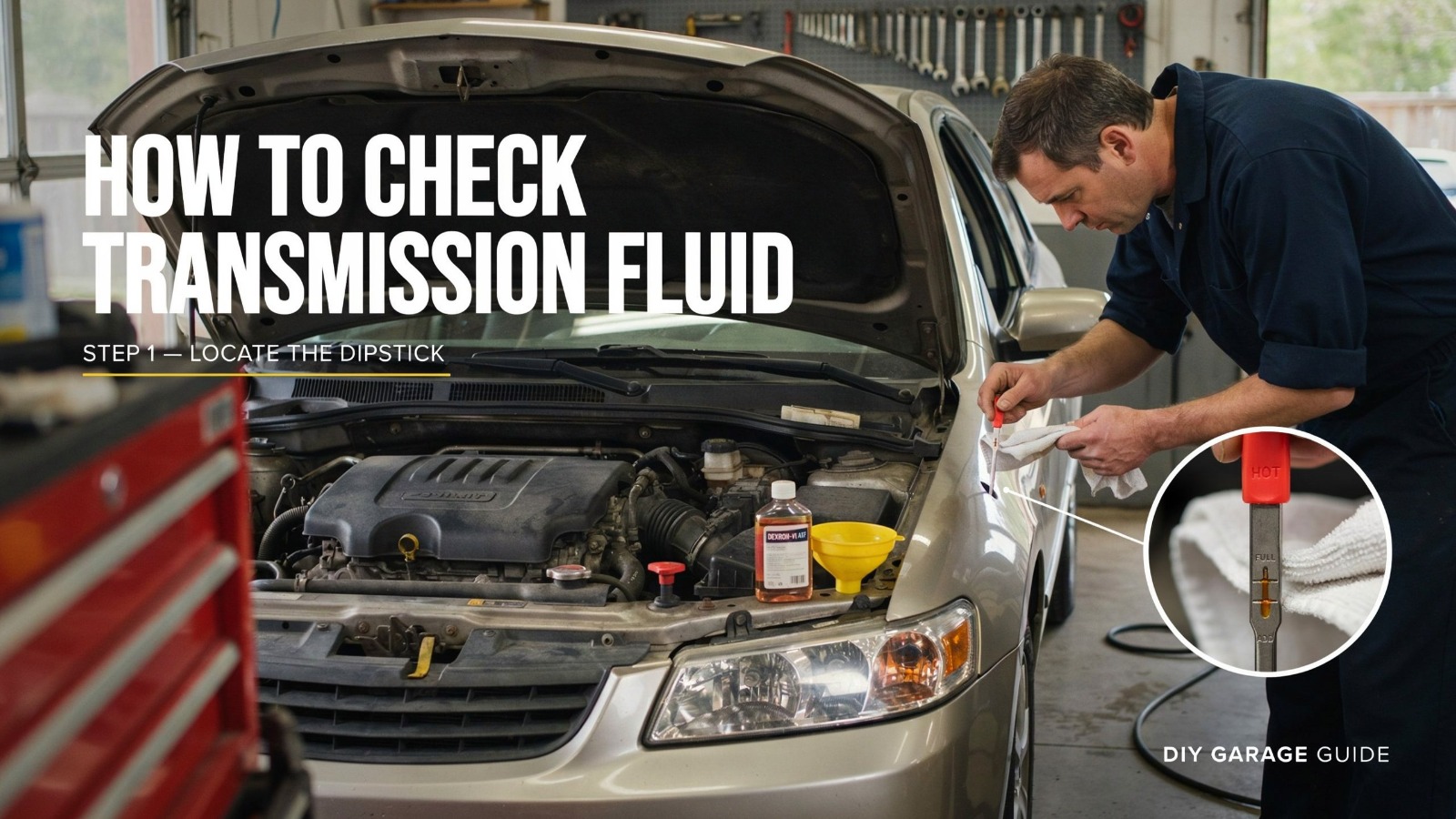
Transmission is one of the most expensive and critical drivetrain components in Your vehicle. It transfers power from the engine to your wheels, allowing your vehicle to change gears as smoothly and efficiently as possible. The process of checking transmission fluid properly is one of the simplest methods for safeguarding this important system. Transmission maintenance is often forgotten until things start going wrong, even though most drivers are aware of the necessity to change the engine oil. But there are things to do regularly, such as checking your transmission fluid before it becomes more expensive in fixing, better shifting of gears and also extending the life of your vehicle.
If you have never checked transmission fluid, it is not a big deal. You will learn → The simplest process, which will take you a few minutes in 4-5 tools. This guide introduces how to check transmission fluid and the symptoms of low or dirty transmission fluid and when to change or refill it. Regardless if you drive a sedan, SUV, pickup truck or crossover knowing how to check transmission fluid is an important part of car maintenance every owner should know.
What Is Transmission Fluid?
What is the purpose of transmission fluid before you learn how to check transmission fluid?Transmission fluid is designed as a special purpose lubricant that keeps the various components of the transmission operating correctly. It decreases friction between moving parts, dissipates heat, prevents wear and allows smooth gear shifts once on the road.
So without more healthy transmission fluid, the transmission may overheat and gear shifts can become hard, leading to serious mechanical damage.Your car might have one of the following types of transmission depending on its kind.
- Automatics Transmission (AT)
- Manuals Transmission (MT)
- Continuously Variables Transmission (CVT)
- Dual-Clutchs Transmission (DCT)
You must supply a different type of fluid in each transmission. The wrong fluid can gravely affect either performance or transmission integrity so always go with what the manufacturer recommends.
Why Is It Important to Check Transmission Fluid?
Many people ask — My vehicle is functioning fine, why do I need to learn how to check transmission fluid? The answer is simple, better to pay several hundred or thousand dollars in repairs due to early detection of problems. Getting your transmission fluid checked regularly has a number of advantages:
- Helps maintain smooth gear shifting
- Prevents transmission overheating
- Reduces wear on internal components
- Improves overall vehicle performance
- Detects leaks before they become serious
- Extends the lifespan of your transmission
- Help avoid expensive repair bills
Consider the transmission fluid as the blood of your transmission. Like engine oil protects your engine, but vehicle transmission fluid protects one of the most complex systems in your car.
Signs You Should Check Transmission Fluid
While your car may be functioning, there are red flags that signal it is time to check the transmission fluid.
1. Difficulty Shifting Gears
Truly Struggle When Shifting Gears When it take you longer to get through gears or if a few ingagements are harsh, then getting the liquid for transmission should yield its ethos looking meter stream.Low transmission fluid will usually lower the hydraulic pressure that helps your car to shift gears.
2. Slipping Gears
A slipping transmission occurs when engine RPMs spike and the car does not come up to speed as anticipated.A common indication that you need to check transmission fluid immediately.
3. Burning Smell
Transmission fluid that is in healthy condition keeps its temperatures in check.If you smell burning while drive, this can be due to the overheating or loss of protective properties transmission fluid.
4. Strange Transmission Noises
If you noticed any grinding, whining, humming or buzzing noise that occur during acceleration; it may not be get proper lubrication in the transmission. These noises could turn into expensive repairs if they are not attended to in a timely manner.
5. Transmission Warning Light
Transmission performance is often electronically monitored in modern vehicles.Check the transmission system if a warning light for your car has appeared on your dashboard.
6. Fluid Leaking Under the Car
Transmission fluid in general, is bright red (some cases new transmission fluid has a pinkish tint). If a pool of red or brown-red liquid is beneath your parked vehicle, it’s probably a transmission leak that requires your immediate attention.
Tools You’ll Need Before Checking Transmission Fluid
This is one of the reasons most people like learning how to check transmission fluid by themselves since it involves just some basic tools.You’ll need:
- A lint free cloth, or microfiber towel
- Protective gloves
- Flashlight (optional)
- Vehicle owner’s manual
- Safety glasses (recommended))
On some of the newer cars, they have actually a sealed transmission with no dip stick. In such case, special equipment or professional service may require to check the fluid level.
How to Check Transmission Fluid: Preparation Steps
Take a moment to properly prepare your vehicle before opening the hood.
Park on a Flat Surface
Park on a flat level ground to correctly find out the transmission fluid level.
Apply the Parking Brake
This stops the car from rolling forwards while you check the fluid.
Warm Up the Engine
Most manufacturers state that automatic transmission fluid should be checked with the engine at normal operating temperature.
Let your engine warm up for a few minutes before you get started
Read Your Owner’s Manual
For the most part, the general procedure is similar for all vehicles but some manufacturers might suggest checking the fluid with the engine on and others recommend otherwise.
By following the owner’s manual you’ll get a most accurate reading.
How to Check Transmission Fluid: Step-by-Step Instructions
Now that you know what the importance of transmission maintenance is, lets get on into learning how to properly check transmission fluid. Now the process is simple but stick to each step carefully as it will get you an accurate reading and save any avoidable waste.
Step 1: Start the Engine
To check transmission fluid for most vehicles with an automatic transmission, you need to have the engine on. Start your car and let it warm up, you should let your car idle for 5–10 minutes until the transmission reaches operating temperature
NOTE: As a rule of thumb, always read your owners manual first. Some vehicles have different procedures.
Step 2: Shift Through Every Gear
To check transmission fluid for most vehicles with an automatic transmission, you need to have the engine on. Start your car and let it warm up, you should let your car idle for 5–10 minutes until the transmission reaches operating temperature
NOTE: As a rule of thumb, always read your owners manual first. Some vehicles have different procedures.Shift Through All The GearsStaying on the brakes now, creep through the gear selector in each position.
- Park (P)
- Reverse (R)
- Neutral (N)
- Drive (D)
- Low gears (if available)
Hold for 2-3 seconds at each position, returning the gear selector to Park.This functions by letting the transmission fluid flow through the transmission system, thus allowing for higher accurate readings.
Step 3: Locate the Transmission Dipstick
Open the hood, and find the transmission dipstick.It has a red, yellow or orange colored handle on many vehicles. That also depends on the manufacturer, so it will be in a slightly different place.If you cannot locate it, look in your owner’s manual.
Tip: sealed transmissions are found in many of the newer vehicles, and they do not come with a dipstick. Optimally, checking transmission fluid in these vehicles needs particular tools or expert administration through October 2023.
Step 4: Remove the Dipstick
Gently remove the dipstick from the transmission.The end of the dipstick will be wet with transmission fluid.Wipe the dipstick completely clean with a lint-free rag or clean microfiber towel.
Step 5: Insert the Dipstick Again
Slide the dip stick 100 percent again into its tube.Push it all the way down until it is seated.Allow some seconds till you take it out from there for the second time.This second measurement reflects the actual level of transmission fluid.
Step 6: Check the Transmission Fluid Level
Inspect the dipstick markings closely. Therefore, most dipsticks must have the indications shown as follows:
- LOW
- FULL
- HOT
- COLD
- MIN
- MAX
The fluid must be between the maximum and minimum level.If your fluid is below the minimum mark, you will need to first check if any fluid is leaking before adding the correct transmission fluid.
As transmission fluid needs to be taken care of regularly, which can also be a thing that you will learn how to do it so that the small problems can be identified before they become big repairs,
How to Check the Color and Condition of Transmission Fluid
Inspecting the fluid level is merely half of the inspection. Note: You should be looking for the color, smell, condition etc.
Healthy Transmission Fluid
In a healthy automatic transmission, the fluid typically is:
- Bright red
- Light pink
- Clear
- Smooth in texture
If your transmission fluid looks like this, chances are, your transmission is healthy.
Dirty Transmission Fluid
Old transmission fluid often becomes:
- Dark brown
- Very dark red
- Thick
- Dirty
- Cloudy
Dirty transmission fluid also does not lubricate internal parts well.If any of the fluid looks contaminated, replace it according to your car maker’s service schedule.
Burnt Transmission Fluid
A burnt transmission fluid is one of the biggest tell-tale signs.Signs include:
- Dark black color
- Strong burning smell
- Thick consistency
Burnt smell – This transmission fluid colour is either a symptom of overheating or internal wear within the transmission.If you see these signs after knowing how to check transmission fluid, it’s best to have your vehicle checked by a competent technician as soon as possible.
How Often Should You Check Transmission Fluid?
A often-asked question by drivers is ‘How frequently do I have to check my transmission fluid?’
Each manufacturer provides their own recommendations, but as a general rule of thumb:
- Transmission fluid checks every month.
- Check it before long road journeys.
- If you encounter any abnormal shifting or signs of a transmission in your vehicle, check it.
- So all you need to do, is follow the service intervals from your owner’s manual.
A few minutes of inspection can prevent costly transmission repairs.
What If Your Vehicle Doesn’t Have a Dipstick?
The bulk of the transmissions on newer cars are sealed units.Manufacturers also intentionally omit a dipstick from these transmissions because they are designed to resist contaminants and need less frequent service.
If You Have A Transmission That Is Completely Sealed (No Dipstick):
- Do not try to speculate the liquid stage.
- Follow the manufacturer’s maintenance schedule.
- If required, get the fluid evaluated by a skilled specialist
You could damage the transmission by attempting to open one without any proper tools.
Can You Check Transmission Fluid Yourself?
Yes—you can learn to check transmission fluid without a technician in most vehicles.This takes under ten minutes and if there is a transmission dipstick on the vehicle, its even less.In any case, it is wise to come to an expert technician if your vehicle has a sealed transmission or you do not know the process.
One of the easiest maintenance practices that you can implement to enhance the reliability, performance, and longevity of your vehicle while also minimizing costly repairs is checking the transmission fluid regularly.
When Should You Add Transmission Fluid?
When you learn how to check transmission fluid, you might find that the level of fluid is lower than recommended. Therefore, additives such as best transmission fluid can help your vehicle back to its normal regular speech.
Only add transmission fluid if the level is not low. If there is too much, it can cause pressure against the housing leading to foaming, lack of lubrication and burnt internal parts.Before adding fluid:
- Refer to your owner’s manual as deficiencies in the type of transmission fluid being used cost a fortune.
- Park the vehicle on a level surface.
- Check under the car to make sure there are no spills or drips.
- Use a clean funnel to avoid debris entering the transmission
If the fluid level keeps dropping even after re-filling, there could be a leak and it is best to have a professional mechanic take care of it.
Common Mistakes to Avoid When Checking Transmission Fluid
Some vehicle owners commingle this and other beginner mistakes when trying to learn how to check transmission fluid. By avoiding these errors, you can get an accurate reading and protect your transmission.
Checking the Fluid on an Uneven Surface
If you park on the slope, it will give a wrong reading. In general, always park on an even surface before inspecting the fluid level.
Using the Wrong Transmission Fluid
Not all transmission fluids are however created equal as certain vehicles require specific types of transmission fluid. Using the incorrect type may even reduce performance and lead to potential damage in the long-term.
Ignoring Fluid Color
Most only test the fluid level and neglect to check the color, let alone odor. Transmission fluid should appear free and healthy of a burnt odor.
Overfilling the Transmission
But adding too much fluid can be as detrimental as having inadequate levels. When adding some fluid, always top it up and check its levels.
Ignoring Small Leaks
Transmission fluid pooling beneath your vehicle may seem like a harmless occurrence, but even seemingly minor leaks can turn into major concerns when ignored.
Safety Tips
However, when traversing, even if you are going to check or fill the transmission fluid, take note of these precautions:
- Park on a level surface.
- Engage the parking brake.
- Loose-fitting clothing must be kept away from moving engine components.
- Wear protective gloves.
- Avoid touching hot engine components.
- Do not smoke or use an open flame near automotive fluids.
- Properly dispose of the old transmission fluid at a licensed recycling center.
Following these precautions makes the process safer and helps prevent accidents.
Pros and Cons
| Pros | Cons |
|---|---|
| Saves money on routine maintenance | Some vehicles have sealed transmissions |
| Helps detect problems early | Incorrect procedure can lead to inaccurate readings |
| Extends transmission life | Requires the correct transmission fluid type |
| Improves vehicle performance | Some repairs still require a professional mechanic |
| Takes only a few minutes | Mistakes like overfilling can cause damage |
Frequently Asked Questions (FAQs)
1. How often should you check transmission fluid?
Long road trips or checking the transmission fluid, as most specialists suggested doing every month. And if you see rough shifting, gears slipping or a transmission warning light, then it should also be checked..
2. Can I check transmission fluid when the engine is cold?
A few vehicles will permit it, while others also need the engine to be warm and running. Your Owner’s Manual will always be the best guide for accurate results.
3. What color should transmission fluid be?
New or good transmission fluid is typically bright red or light pink in color. If it has turned dark brown, black or smells burnt then it should be replaced.
4. What happens if transmission fluid is low?
Lack of output fluid leads to delayed gear shifts, slipping gears, overheating, noises or additional wear and tear on all internal components.
5. Can I drive with low transmission fluid?
Low transmission fluid is bad for your car! If you let it go, it may result in major transmission problems that cost a fortune to resolve.
6. How long does it take to check transmission fluid?
It takes about 5–10 minutes to check the fluid if your vehicle has a transmission dipstick.
7. Do all cars have a transmission dipstick?
No. Recent cars have sealed transmissions, where you can only check the fluid some other way or with special equipment in a garage.
8. Can I add transmission fluid myself?
Yes, but ONLY if it is a dipstick car and you are using the proper fluid recommended by the manufacturer. Add gradually and check the level to determin if you overfilled?
9. What are the signs of bad transmission fluid?
Common signs include:
- Rough gear shifting
- Burning smell
- Dark or dirty fluid
- Slipping transmission
- Strange noises
- Transmission warning light
10. Why is learning how to check transmission fluid important?
Learning to check transmission fluid can help identify transmission troubles early, get better vehicle performance and fuel economy, save you money on costly repairs and extend the life of your car or truck’s transmission.
Final Thoughts
When it comes to developing vehicle maintenance skills, one of the simplest and most beneficial things you can learn is how to check transmission fluid. Taking a moment to inspect once a month will allow you to catch low fluid levels, find leaks and see signs of worn or contaminated fluid before they become costly repairs.As long as you know the right way to do it, use transmission fluid that is recommended by the manufacturer and heed warning signs such as rough shifting or strange sounds, you should be able to get several years of service out of your transmission without any problems.
Whether you’re a new driver or an old car owner, as you got check-up your transmission fluid into habit and regular maintenance is one of the best investments that contribute to your vehicle’s performance and overall reliability like no other.That said, if you ever find yourself questioning the state of your transmission even a little, or if your vehicle is sealed and there isn’t a pump and drain available to service it properly, definitely get in touch with someone at a shop. It is always cheaper to take preventive maintenance than repairing transmission for that matter.