
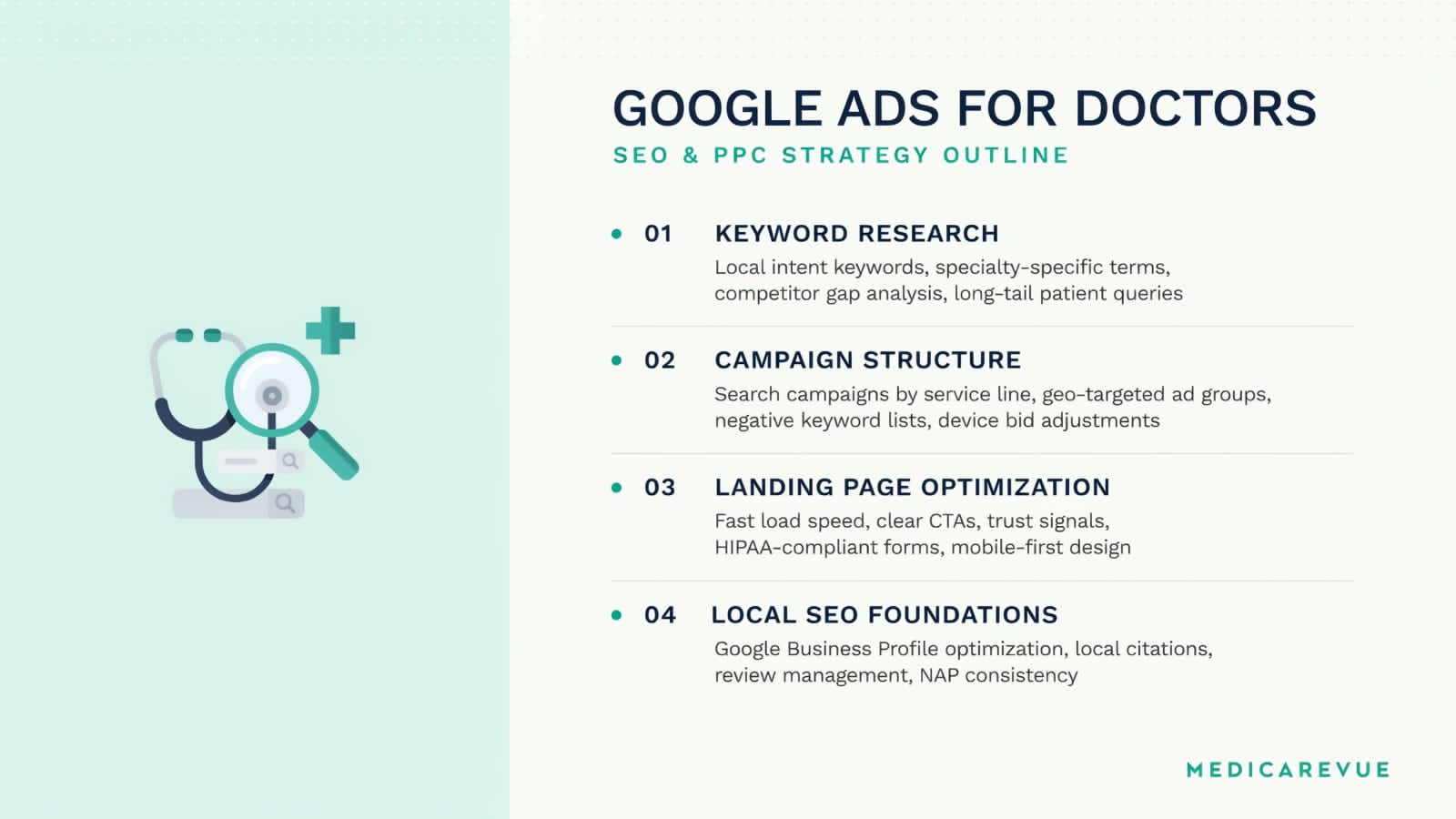
To run a successful Google Ads campaign for your medical practice, it takes more than picking some keywords and throwing money at the cause. Because healthcare advertising is so competitive, doctors need a paid ad + search engine optimization strategy to attract only qualified patients. Google ads for doctors SEO outline should be planned in a way to organize everything about every stage of your campaign — keyword research, ad creation, landing page optimization and performance tracking involved.
If you run a dental clinic, dermatology practice, family medicine center, or specialty hospital, a structured outline helps simplify the construction of campaigns that generate appointments over wasted clicks. This also ensures that your ads match both patient search intent and what Google will allow in terms of advertising.
And today, this guide is going to explain everything you need to know in order to build a doctor SEO Outline that works for you through Google Ads. To get started, you can learn keyword research structuring campaigns writing ad copy landing page optimization and success tracking with actionable strategies that work for beginners and experienced marketers.
What Is a Google Ads for Doctors SEO Outline?
Google Ads for Doctors SEO Outline — A structured strategy that ties in Google Ads with a search engine optimization strategy to help the potential patients find more patients online.An outline helps you get an overview of all the important elements before launching campaigns and going to spend your advertising budget, rather than winging it.A professional outline typically includes:
- Business goals
- Target audience
- Keyword research
- Campaign structure
- Ad copy planning
- Landing page optimization
- Budget strategy
- Performance tracking
- Conversion optimization
Using an outline saves you from blunders and allows better performing campaigns.
Why Doctors Should Use a Google Ads SEO Outline
Several healthcare providers invest in Google Ads but fail to produce good quality patient leads because their campaigns are not designed with a clear strategy.
This is a structured Google Ads for Doctors SEO Outline to help you:
- Access the patients who are looking for your services
- Improve click-through rates (CTR)
- Reduce wasted advertising spend
- Increase appointment bookings
- Improve landing page experience
- You have access to data right until October
You will be road mapping a data-driven strategy that is engineered for long term success, rather than guess work.
Benefits of Google Ads for Medical Practices
Google Ads offers several advantages for healthcare professionals looking to grow their practice.
Immediate Online Visibility
And in contrast to SEO, which can take months before you see the fruits of your efforts, Google Ads can get your clinic on top of search almost instantly.This makes it simpler to reach out to people that are looking for healthcare services.
Reach High-Intent Patients
Google Ads provides the opportunity to reach a target audience that has an interest in career-oriented medical services.Examples include searches like:
- Family doctor near me
- Pediatric clinic
- Dentist open today
- Skin specialist
- Orthopedic surgeon
Such users are much more likely to make an appointment than those reached by advertising at large.
Better Budget Control
Doctors can choose:
- Daily budget
- Monthly budget
- Maximum bid
- Target location
- Device targeting
- Ad schedule
This flexibility allows them to effectively limit advertising costs while reaping the maximum benefits.
Track Campaign Performance
You have access to granular campaign performance details in Google Ads.You can monitor:
- Clicks
- Impressions
- Cost per click (CPC)
- Conversion rate
- Appointment requests
- Phone calls
- Return on ad spend (ROAS)
You can track these metrics to make the right decision and constantly improve your campaigns.
Understanding Patient Search Intent
Understanding why people search is a prerequisite to creating ads.Most searches having to do with health care fall into three general categories.
Informational Searches
Health-related questions are on the mind of users.
Examples:
- Symptoms of flu
- Back pain causes
- Best treatment for migraines
Those searches are certainly more appropriate for the type of content you would write for an SEO blog.
Commercial Searches
Utilizing the Doctor Comparison Feature By Users Before Steps Towards A Decision.
Examples:
- Best dentist in Chicago
- Top orthopedic clinic
- Affordable dermatologist
High-converting landing pages will complement Google Ads effectively for these types of searches.
Transactional Searches
These users are prepared to schedule an appointment.Examples include:
- Dentist near me
- Emergency doctor
- Eye clinic open today
Such keywords are often highly illustrative of customer intent and you should leverage them for the best conversion rates, therefore, 1-3 keywords must be given priority above all in your campaign.
Step 1: Define Your Campaign Goals
The foundation of any Google Ads for Doctors SEO Outline is clear objectivesCommon goals include:
- Increase appointment bookings
- Generate phone calls
- Promote a new medical service
- Grow brand awareness
- Increase website traffic
- Improve local visibility
Keep your strategy centred around one primary goal for each campaign.
Step 2: Identify Your Target Audience
Knowing your ideal patients leads to more tailored ads.Consider factors such as:
Location
Advertise locally instead of nationwide and target patients within your service area.
Age
Various services draws near for different age groups.For example:
- Pediatrics → Parents
- Orthopedics → Adults and seniors
- Cosmetic dentistry → Young professionals
Interests
While search campaigns depend primarily on keywords, an understanding of patient interests enables more compelling messaging.
Devices
The majority of healthcare searches occur on mobile devices.Make sure your landing pages load quickly and are mobile-friendly.
Step 3: Conduct Keyword Research for Doctors
The foundation of every successful Google Ads for Doctors SEO Outline – keyword research Keyword Consideration — using these determines how your ads will find users that are looking for medical services.
Avoid optimising your site for the higher volume, more competitive keywords and optimise instead for keywords that demonstrate buy signals and fit into your niche.
Primary Keywords
Primary keywords are the services you mostly offer, 1 and hence must be prioritized.Examples include:
- Family doctor near me
- Pediatric clinic
- Orthopedic surgeon
- Dentist near me
- Dermatologist near me
- Eye specialist
- Urgent care clinic
Such keywords are generally used by the users who are willing to make an booking.
Long-Tail Keywords
Long-tail keywords are more specific and tend to convert better because they match a user search exactly.Examples:
- Best pediatrician for newborns
- Affordable dental implants near me
- Emergency orthopedic doctor
- Female gynecologist accepting new patients
- Same-day dermatologist appointment
Long-tail keywords—far less competition and much higher intent.
Local Keywords
As medical practices heal patients in a locality, local SEO can not be neglected.
Examples:
- Dentist in Dallas
- Cardiologist in New York
- Pediatric clinic in Houston
- Skin specialist in Miami
If you want patients off in your area, add keywords regarding buying your city or community.
Step 4: Organize Your Google Ads Campaign Structure
A structured campaign enhances Quality Score, improves relevance and simplifies optimization.Here is an example of a simple campaign structure:
Campaign
Dental Clinic Services
Ad Group 1
- Dental Implants
- Tooth Replacement
- Implant Dentist
Ad Group 2
- Teeth Whitening
- Cosmetic Dentistry
- Smile Makeover
Ad Group 3
- Emergency Dentist
- Tooth Pain
- Same-Day Dental Care
Organize your ad groups around one service using very tightly-related keywords.
Step 5: Write High-Converting Ad Copy
The fact of the matter is, your ad copy is typically a potential patient’s first encounter with your practice. Your message needs to be clear as a bell, credible like the wall street journal and an active call to action.Healthcare ads with high strength usually have the following:
Headline
- Experienced Family Doctors
- Book Your Appointment Today
- Trusted Dental Clinic Near You
Description
Highlight your unique value.Example:
“Get personalized medical treatment from specialized doctors. Same-day appointments available. Book online today.”
Call-to-Action (CTA)
Use direct CTAs such as:
- Book Now
- Schedule Today
- Call Our Clinic
- Get a Free Consultation
- Find a Doctor
Healthcare is sensitive and ads must abide by Google. Never make any overhyped claims nor deceptive statements.
Step 6: Optimize Your Landing Page
You’re only as strong as your ad Well, not really, all the eyes in the world are useless if they leads to a bad landing page. The landing page you use must be a direct match between what is promised in your ad and what the user experiences when they arrive there.
Include These Elements
- Clear page headline
- Brief service description
- Doctor’s qualifications
- Patient testimonials
- Contact information
- Appointment booking form
- Click-to-call button
- Clinic address and map
- Frequently Asked Questions
Your conversion rate can be highly increased with a minimal-load, mobile-responsive landing page.
Step 7: Set a Realistic Advertising Budget
Budget flexibility is one of the greatest advantages that comes with using Google Ads. Set a daily budget at an amount you are comfortable with and then optimize based on how your campaign is performing.When planning your budget, consider:
- Cost per click (CPC)
- Monthly advertising goals
- Expected appointment value
- Competition in your area
Do not increase your budget right away, and rather spend time optimising keywords, ads and landing pages for better ROI.
Step 8: Use Negative Keywords
Negative keywords help you save money and improve campaign performance by preventing your ads from showing for irrelevant searches.Examples of negative keywords include:
- Free
- Jobs
- Salary
- Training
- Course
- Internship
So if you have a dental clinic, do not display an ad for searches like “dentist jobs” or “dental assistant salary.”
Negative keyword creation — Part of every Google Ads for Doctors SEO Outline is regular monitoring of your search terms report and adding negative keywords.
Step 9: Set Up Conversion Tracking
They do not just stop after launching a campaign while writing Google Ads for Doctors SEO Outline successfully. You want to measure the events that occur after users have clicked on your ad. This is where conversion tracking comes into play — it tells you which ones lead to actual patient inquiries, and how well your ads are performing.Track important actions such as:
- Appointment bookings
- Phone calls
- Contact form submissions
- Online consultation requests
- Live chat interactions
- Direction requests
Tracking these conversions allows you to scale up campaigns that drive real results and not just clicks.
Step 10: Improve Your Google Ads Quality Score
Quality Score—Google’s rating of your ads determined by the relevance, expected CTR, and landing page experience. Higher quality score can reduce your CPC as well as achieve better ad placement.
Ways to Improve Quality Score(Use Relevant Keywords)
Insert your target keywords loosely in:
- Headlines
- Descriptions
- Landing page titles
- Body content
Keep keyword closely related to the search of user.
Write Better Ad Copy
Your ad needs to respond to the question the user asked right away.Put focus on benefits rather than generic text:
- Experienced doctors
- Same-day appointments
- Board-certified specialists
- Easy online booking
- Convenient location
Good wording near and right encourages readers to click even more.
Improve Landing Page Experience
Google likes landing pages that are informative and load instantlyA quality landing page should:
- Load in under three seconds
- Work smoothly on mobile devices
- Clearly explain the service
- Include a visible call-to-action
- Match the content of the ad
Quality Score is often correlated with a better landing page and more conversions.
Step 11: Optimize Your Campaign Regularly
Campaign creation is just the start. Ongoing optimization keeps performance on-point and cuts down wasted spend.Evaluate your Campaign on a Weekly Basis and Experiment with:
- High-performing keywords
- Low-performing ads
- Click-through rate (CTR)
- Cost per conversion
- Search terms report
- Quality Score
- Conversion rate
Only pause those keywords that do not result in any new patient inquiry and amplify the budget for campaigns which continuously bring you new patients.
Step 12: Use Ad Extensions
Ad extensions are additional information that helps your ads stand out in search results.Useful extensions for doctors include:
Call Extension
It gives patients the option to call your clinic directly from the ad.
Location Extension
Showcases your clinic’s address and will help local patients locate you too.
Sitelink Extension
You lead the user to pages that matter:
- Book Appointment
- Meet Our Doctors
- Services
- Insurance Information
- Patient Reviews
Callout Extension
Highlight benefits like:
- Same-Day Appointments
- Experienced Specialists
- Emergency Care Available
- Online Booking
- Friendly Staff
Ad extensions can sway impressions and increase click rates.
Common Mistakes Doctors Should Avoid
Even the best-funded campaigns can falter if they ignore basic best practices. Here are some common mistakes you should avoid when creating your Google Ads for Doctors SEO Outline.
Targeting Too Many Services in One Campaign
Keep campaigns focused. Group separate services into their own campaigns or adgroups so that you can be more relevant and run better ads.
Ignoring Mobile Users
Smartphones account for most healthcare searches.Make sure your website:
- Loads quickly
- Uses large, readable text
- Has clickable phone numbers
- Includes an easy appointment form
Mobile conversions drop-off can be linked to a poor mobile experience.
Using Generic Landing Pages
Driving users to your homepage rather than a dedicated service page usually leads to lower conversions.You need to make sure that every ad conforms to the intent of search for the user goes to a landing page.
Not Reviewing Search Terms
Search Terms Report: Be sure to regularly check this for irrelevant searchesNegative keys reduce ad waste so that you make better use of your budget.
Focusing Only on Clicks
A lot of clicks do not necessarily mean a good track record.Instead, measure:
- Appointment bookings
- Phone calls
- Consultation requests
- Cost per lead
- Return on investment (ROI)
Now, these metrics are a more realistic reflection of how your campaigns are performing.
Advanced Tips for Better Results
So if you want to outperform your campaigns in comparison to your competitors, try some of these more advanced strategies:
- Local keywords to visit nearby patients.
- Separate campaigns per medical service
- Run A/B testing on different headlines and descriptions.
- Get positive patients to write reviews on Google.
- Optimize page speed & lower bounce rates.
- Place ads when your clinic is actually open.
- Update your negative keyword list on a regular basis.
- Dig into other competitors and find new keyword opportunities.
Implementing these best practices, you will create a much more effective Google Ads for Doctors SEO Outline that attracts qualified leads and ultimately helps your return on advertising cost.
Pros and Cons
| Pros | Cons |
|---|---|
| Reaches patients actively searching for healthcare services. | Highly competitive in some medical specialties. |
| Generates faster results than SEO alone. | Cost per click can be expensive. |
| Allows precise location and audience targeting. | Requires regular campaign monitoring. |
| Provides measurable performance and ROI. | Poorly optimized ads can waste budget. |
| Helps increase appointment bookings and phone calls. | Healthcare advertising must follow strict Google policies. |
Frequently Asked Questions (FAQs)
1. What is a Google Ads for Doctors SEO Outline?
A Google Ads for Doctors SEO Outline is a defined plan that brings together Google Ads with plenty of tips and tricks around SEO. It documents keyword research, campaign organization, landing pages and ad copy to enhance performance tracking of medical practices who want to attract qualified patients.
2. Why is a Google Ads for Doctors SEO Outline important?
A proper Google Ads for Doctors SEO Outline eliminates unnecessary ad spend, increases relevance, speeds up conversions and targets patients looking to find a doctor online.
3. Which keywords should doctors target in Google Ads?
For example, doctors need to optimize for high-intent keywords relevant to their practice and locality.
- Dentist near me
- Family doctor near me
- Pediatric clinic
- Dermatologist in Chicago
- Emergency dental care
The best results often come from long-tail and location-based keywords.
4. How much should doctors spend on Google Ads?
There is no fixed budget. Clinics typically begin with a budget that won’t hurt it too much and scale up or down based on how the campaigns work, competition, and how much it’s worth to acquire another new patient. The ROI is more important than just spending, саме так.
5. How can doctors improve Google Ads performance?
They can enhance how campaigns performs by following these guidelines using doctors:
- Using relevant keywords
- Writing clear ad copy
- Creating fast-loading landing pages
- Adding negative keywords
- Using ad extensions
- Tracking conversions
- Optimizing campaigns regularly
6. Should doctors use SEO along with Google Ads?
Yes. Google Ads provides instant exposure, SEO builds organic traffic over time. Having both strategies-basically balances your online presence and helps you to bring in potential patients through paid ads or organic search.
7. What are the biggest mistakes in Google Ads for doctors?
Common mistakes include:
- Targeting broad keywords
- Ignoring negative keywords
- Sending traffic to the homepage instead of a service page
- Not tracking conversions
- Failing to optimize campaigns regularly
The problem can lead to significant improvements in campaign performance.
Conclusion
Having an excellent SEO Outline for Google Ads for Doctors is one of the best ways to reach new patients while maximizing the value of your ad spend. With intelligent keyword research, organized campaigns, top-quality compeling ad copy and landing pages, as well as tracking the campaign performance into account medical practices could gain more qualified leads in return for their investment.
Keep in mind, Google Ads campaigns require continual optimization, not a one time set it and forget it approach. Competition in healthcare marketing is only going to get fiercer, and following a clear and structured strategy will ensure your practice stands apart from the crowd, targets an audience that matters, and represents a sustainable growth path via paid-search advertising.